
Introduction
In forex trading, momentum indicators help traders gauge the strength of price moves and one of the most popular among them is the Relative Strength Index (RSI). RSI-based signal strategies are widely used to identify potential trend reversals, continuations, or entry and exit points. But how do these strategies actually work? Let’s explore.
What Is RSI?

The Relative Strength Index (RSI) is a momentum oscillator that measures the speed and change of price movements. It ranges from 0 to 100 and is typically used with the following thresholds:
- Above 70: Overbought condition (potential sell signal)
- Below 30: Oversold condition (potential buy signal)
RSI is not just about overbought or oversold it’s also about momentum, divergence, and confirmation.
Core Components of RSI-Based Strategies

Here’s how RSI is commonly used in signal generation:
1. Overbought/Oversold Reversals
- Buy Signal: When RSI dips below 30 and then moves back above it.
- Sell Signal: When RSI crosses down from above 70.
Example:
RSI drops to 28 → signals oversold → price action confirms reversal → long entry triggered.
2. RSI Divergence
- Bullish Divergence: Price makes a lower low, but RSI makes a higher low → potential upward reversal.
- Bearish Divergence: Price makes a higher high, but RSI makes a lower high → potential downward reversal.
These are powerful early-warning signals of momentum shifts.
3. RSI Trend Confirmation
- In strong trends, RSI tends to stay in extended zones:
- Uptrend: RSI stays between 40–80.
- Downtrend: RSI stays between 20–60.
Use Case:
Traders combine this with price action or moving averages for confirmation.
How RSI Signals Are Generated in a Trading System

Here’s a simplified flow of how RSI-based signals work in automated systems:
- Data Input
- The system scans RSI values across multiple timeframes.
- Trigger Conditions
- For example: RSI < 30 + bullish divergence + price above 50 EMA.
- Signal Confirmation
- Optional volume spike or candlestick confirmation (e.g., bullish engulfing).
- Signal Dispatch
- Once all conditions match, a buy/sell signal is sent out via email, app, or dashboard.
- Exit Plan
- RSI reverts to neutral (e.g., crosses 50), or a trailing stop is hit.
Why RSI-Based Strategies Work
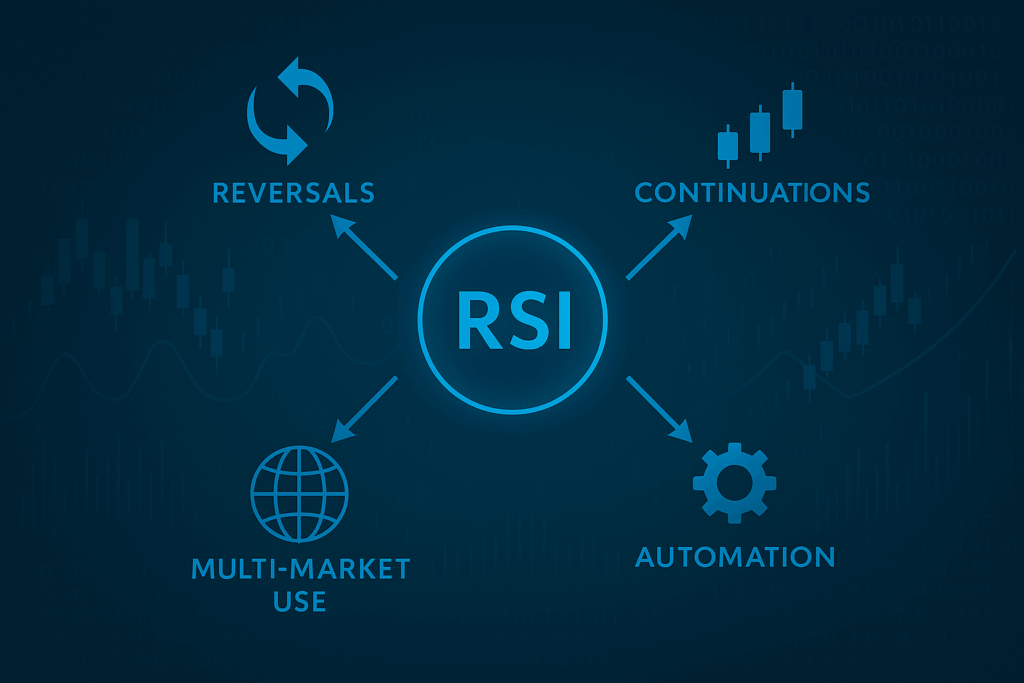
- Quantifiable: Clear numeric values make them easy to automate.
- Widely Trusted: Used by traders across all markets.
- Versatile: Can be used for reversals, continuations, and even range trading.
Pitfalls to Watch For

- False Signals in Trending Markets: RSI can stay overbought/oversold for long periods.
- Needs Confirmation: RSI alone is not a perfect entry tool should be paired with other indicators.
- Lag in Volatile Markets: May trigger signals too late when prices are moving fast.
Final Thoughts
RSI-based signal strategies provide traders with a flexible and powerful tool for understanding price momentum. Whether you’re swing trading or scalping, combining RSI with other technical tools can enhance signal reliability.
At SignalsGrid, we use refined RSI models as part of our signal engine taking into account multi-timeframe analysis, divergence patterns, and price structure so you don’t have to second-guess your trades.